Thursday, January 24, 2013

The Fiesta in Yauyos, part 1: The Dancers

I live in the small town of Marco, and the nearest city is Jauja, with about 20,000 people. Jauja is really two cities: Jauja and Yauyos. This week is the annual fiesta in Yauyos. There are 26 orchestras in town for the fiesta, each associated with a group of dancers. On Sunday, I went to watch the dance competition and judging.


All around the plaza the streets were lined with stalls selling food and goods. Pork was popular. And here, it’s really clear that pork comes from a pig. Recently.


 And that meant lots of work for the knife sharpener.
I stopped for a treat at this stall.


A family from Marcos was there. This neighbor recognized me and sat with me to keep me company.

After my snack, I went to see the action. In the plaza, the dancers performed in the center of the plaza.

On a stage nearby, the orchestras played.


And the announcers kept us informed.
 The judges watched and gave scores
All around the plaza, there were wooden viewing stands that had been erected so people could watch the show.


Each group of dancers marched in with their banner, carried by leaders from their sponsoring organization. These people are probably the steering committee of a community farmer’s association.

For the dance featured at this fiesta, there is a set cast of characters. Every dance troupe has examples of each character. This is “Chapeton”, a parody of the ruling class during the conquest era. Chapeton always has large handkerchiefs, a plumed hat and embroidered knee pants.
But is just as tied to the cell phone as you or I.

Here’s “Jaujina”, who represents the mestizas, the children of intermarriage between the native Xauxinos and the Spanish. She represents the upper classes.

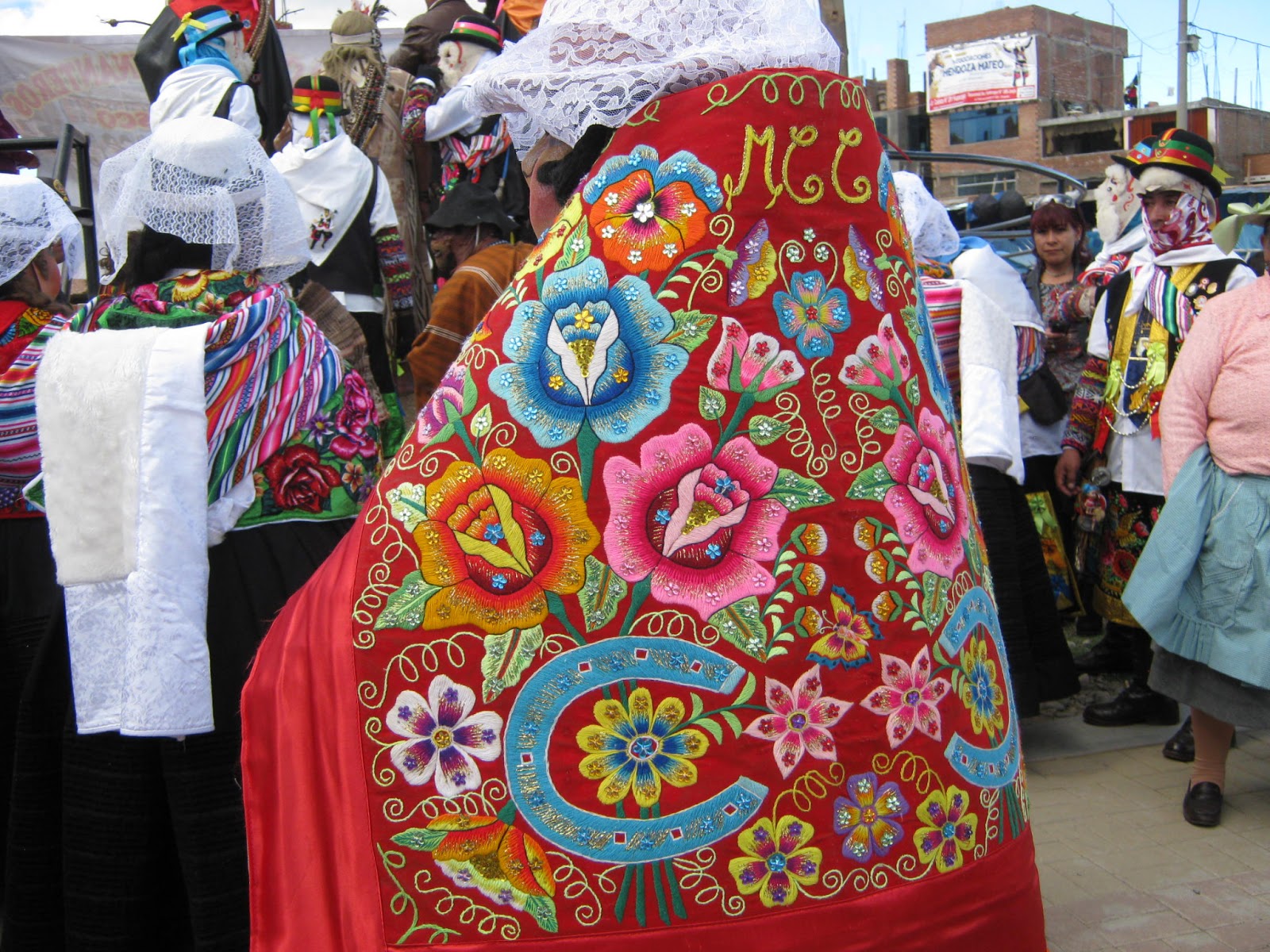
Huanaca represents the descendants of the Inca, and the upper class of Xauxa who made alliance with the Spanish invaders and settled into the middle class. These dancers had amazing embroidered mantas and dresses. Here’s front and back of one costume:


And another


 This character is “Chuncho”, who represents the people of the jungle. Chuncho usually carries a bow and arrow, to represent the role they played in the fight for independence from Spain. He carries products of the jungle as well. For thousands of years there has been brisk trade between the Andes, where I live, and the jungle to the east.

There are two characters with fuzzy white masks. Chuto is middle class, and is a clown character who interacts with the public. He often has a pipe.

Indio is lower class and represents the exploited campesinos.

These two are the domineering Maria Pichana and her cowed husband Viejito.
Cuzquena represents a woman of Cuzco, with her artisan goods

And Jamille is the curandero, or herbalist.
 Arriero is the trader, from Argentina, who travels everywhere and encounters all the other types of characters.
 I noticed that this character always wore spurs.
 That got me interested in feet. Here's part of my series of photos of dancers’ feet.


I watched from one of the stairways to the stage. This little girl shared my step.

After a while, I took a stroll around the plaza. There were plenty of goods offered for sale.


I bought anitcuchos (grilled slices of beef heart), one of my favorite Peruvian foods. Of course, you get potato with that. In the Andes, you get potato with everything.


I love the fiestas here.

Monday, January 14, 2013

The tara seeds

Here I am at the swearing-in party. This is my boss, Diego.


Diego wants all of us in the environment unit to plant native tree species. He gave each of us a large bag of the pods of his favorite native tree, tara.


I am here to tell you that shelling those pods is a lot of work.
 
In my town, there’s a technical college. One of its programs is agriculture. I met with the students and department chair and took a tour of their facilities. They have lots of cool stuff: worm compost, experimental fields, special cows, and so on. However, their vivero (tree nursery) floods during rainy season. We decided to build a new vivero and do a tree experiment together. I gave a charla on viveros and we agreed on a plan.


After a few false starts, the day came to plant the seeds. There were 4 conditions in this 2x2 factorial design: with and without soaking crossed with whole vs. shells clipped open. Hypothesis: soaking will only improve germination if the seed shell is clipped.


We spent a long time getting the soil ready (equal parts worm compost, sand and agricultural soil) and then stuffed our bags with soil and planted 2 seeds per bag. If both germinate, the weaker one will be culled.

 
We were very productive

Now the trees are tucked under a tree at the institute, beginning to sprout. We should have baby trees to plant in a few months. It’ll be dry season, so we’ll plant them along the irrigation ditch so they’ll be easy to water. We're starting to see germination, but so far I don't see a difference between the conditions. And I'm not sure yet what is a tara tree and what is a weed.
But something is sprouting.

So, Diego, I hope you’re pleased.

Friday, January 11, 2013

Commission Ambiental Municipal de MARCO!

WOW! Que buena suerte!!!
In my first monthly report to my supervisor, Diego, I told him that what my community could really use is its own environmental action committee, a.k.a. Commission Ambiental Municipal, or CAM. That was at the end of December. Well--swoop--we have one! I requested support from my new friends the provincial-level environmentalists (described in an earlier post) and they came to Marco and held a meeting on how to form our own commission on the environment. We had reasonably good attendance and started only 45 minutes late. It may have helped that when the driver went out to hand-deliver the invitations to the meeting, I went along and asked each official personally to attend. I also gave out a Peace Corps flier explaining what a CAM is and copies of my business card.
It was a real eye-opener to see how my municipality goes about calling a meeting. There is no postal service home delivery in Marco. Hardly anyone has a phone, much less email. Instead, one of the workers at the municipality (town hall) signs out the car (having a government car is a very recent innovation, too) and goes to find the people who are asked to attend the meeting. Each person signs for their invitation (stamping it with their personal rubber stamp if at all possible) and the pages go back to the secretary to show who actually got an invitation. Fortunately, the drivers know a lot of people, so we were able to track down the various officials in their offices, homes and potato fields.
The meeting was run by Joel, secretaria tecnica del sub-gerencia de gestion ambiental de Jauja. This guy is good. Anyone who has taken my environmental psychology course could just skip the unit on motivating people to protect the environment--instead, just follow Joel around. I'm really glad he's 'Using His Powers for Good', because if he wanted to run a cult, he could have them drinking Kool-Aid within days. He's a force of (and for) nature. By the time he was done, we understood what a CAM is and why we should want one, had voted to form a CAM for the district of Marco, had elected leaders, and had all sworn to serve the committee and fight for the environment. Here's Joel and the new CAM giving our juramiento:
After swearing to serve, we signed the Acta that established the commission in the municipal libro de actas (book of decisions), and stamped the page with our official stamps. (Thank you Jaime and Diego, for my own personal PC-MAC stamp, so I can be suitably formal in these situations.)
On the left in the above picture is the representative of the national government and on the right is the doctor from our health post. Both agreed to serve as officers. This is probably the best news of all. They are doers, well-respected and genuinely committed to improving the environment in our little town. What this means to me is that I've found my socios (local work-partners). Tears came to my eyes when they agreed to lead us. One of the primary determinants of the success of a Peace Corps volunteer is finding motivated local people to work with. My chance of actually accomplishing something in my two years here just increased tenfold.

After the signing, we went outside in front of the town hall to have our picture taken as a group, another requirement at any occasion of import.
That's Joel in the middle, in the suit, hands folded in front. Watch this guy, he should be running the Ministry of the Environment in a few years.

Now, just for some local color, here are some guys who were set up in the middle of my road, making a cement roof for a house. I took a picture of them on my way home.

Naturally, this resulted in some showing-off for the camera.
Peace Corps can be tough. Seriously--it can be really, really tough.
But this was a good day.

Thursday, January 10, 2013

Daily realities

A friend back home said she was envious of my ideal life in Peru. It's fascinating, yes. Ideal, not so much.

So, let me tell you about life without a bathroom.

To get to the latrine, I must pass through the barnyard, which is coated in cattle excrement.
When the cows are home, I have to push my way past them to get out. I'm kind of scared to do that, so I don't use the latrine at night. I have a chamberpot. Here are some of the cows (we have a bull, 4 cows and a calf). They're not Fierce Cows, just a bit much for me in the dark of the night.

 The latrine is out into the field behind the house. Here it is:

The view is nice.

But here’s the ‘toilet’.

I guess this is the moment to share with you that Peace Corps musical hit, “You’re gonna poop in a hole”. Have a listen. Please. It’s all true.

We have running cold water, but there is no bathroom. I participate in that great Peace Corps tradition, the bucket bath. I bathe in my bedroom. Here is my bath:


I heat up some water, so it’s a bit more comfortable, given that the temperature in my room is usually about 55 degrees. I can wash my hair and all the "parts that fold" with one Nalgene (liter) of water or less. I have discovered that baby washcloths are readily available; they do the job, are gentle on the skin, and dry quickly. I also highly recommend this type of clothespin rack for hanging towels and washcloths to dry in your room. Also excellent for drying socks and underwear without taking up a lot of space on the clothesline, and can be moved inside quickly when the rain and hail start. These handy things are available in the market at the same stall where you purchase your chamberpot.

Also, while we’re mentioning daily realities, there’s the mud. My road becomes brown slurry when it rains, and right now it rains a lot. Fortunately, I have ditch boots and (so far) they don’t leak. Here’s the street outside my house after a rain. Also, notice the local trash disposal system at work.
 
It's not that I'm complaining. As you could tell from the song "You're gonna poop in a hole", this is how it's supposed to be in the Peace Corps. If all the amenities existed, they wouldn't need us and I wouldn't get to have this amazing experience, living in Peru. And how could we understand the daily realities of the people we're serving if we didn't share those realities on a daily basis?

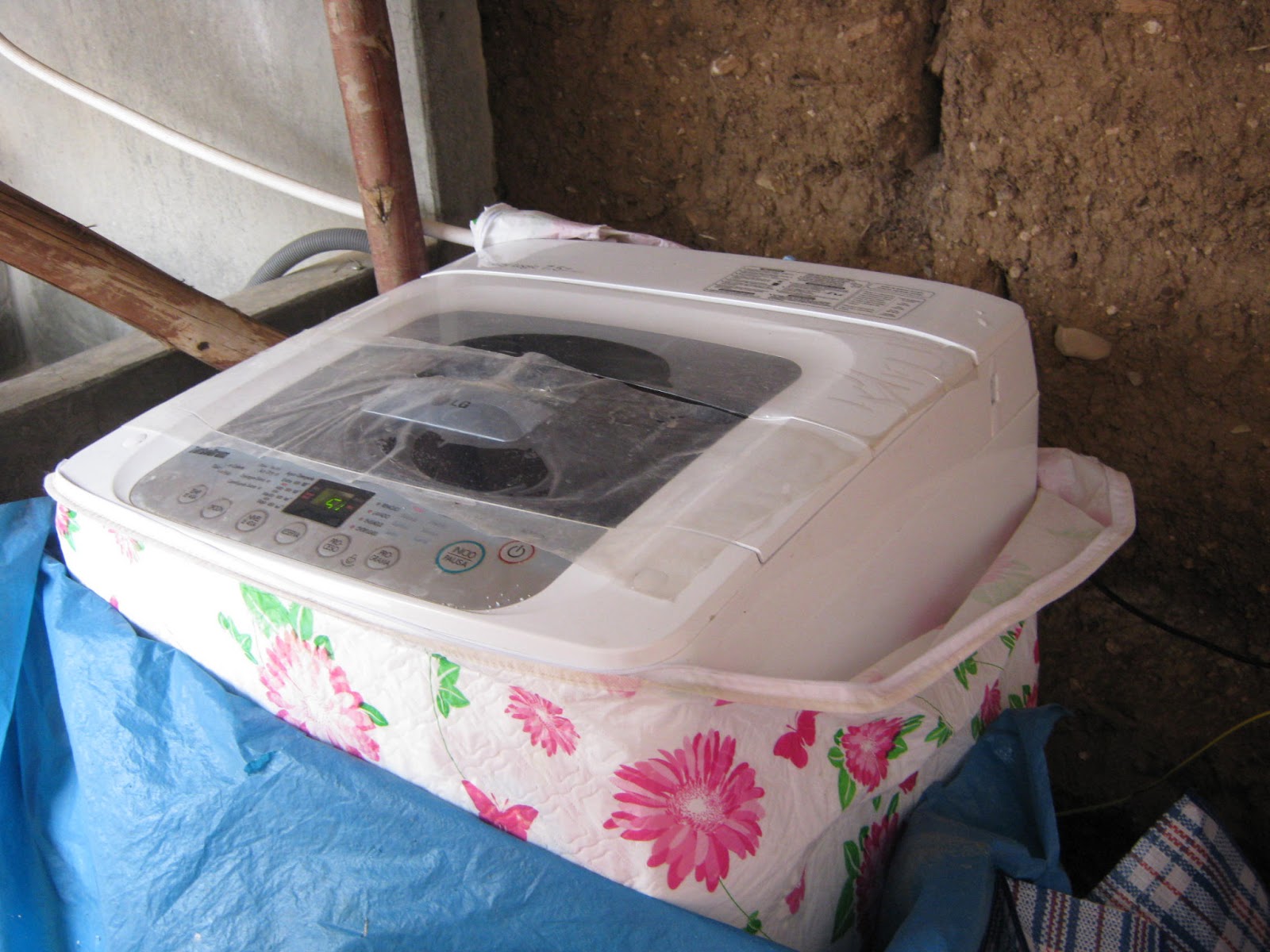
Actually, my house has some facilities that might make volunteers in, say, Africa, sneer and label my site "Posh Corps". We have a washing machine!!!


And for my host moms birthday, my host sister gave her a microwave!!!
 It is true, hot running water would be nice. My last shower was when we had our December Junin volunteer meeting in La Merced, and I stayed in a hostel.

 That was a month ago. I can't think of a time in my life when I've gone a month without a shower. And actually, it doesn't bother me; I'm already used to it.

So, for any of you who are jealous of my adventure, just remember, it’s not all this.


It’s also this:


Monday, January 7, 2013

Largesse from the USA or They Stole my Goldfish

I got a package from my parents, full of Christmas presents. It came just after New Year’s. It probably took a while to get here because it was stopped by the postal police in Lima. They opened it and checked a few packages, then sent it on to the post office in Jauja. After several pages of paperwork, the Jauja office released it to me. I brought it home and opened it in my room. Lots of packages, a little Christmas tree with ornaments, and some new window clings for my collection. It was very exciting!!!
I set up the tree and arranged the packages around it, so I could savor the anticipation.

We admired them from the courtyard, too.


The next day, I succeeded in both finding a connection stable enough for Skype and reaching my parents at home in the USA. In the internet café, I opened my whole pile of presents while on Skype. It was a lot of fun to talk with my parents about each present and thank them for their thoughtfulness. We were on for an hour. The teenagers playing games on the other computers kept giving me quizzical looks as the wrapping paper piled up around my feet.

When we finished, my mother said there was one package missing: a container of goldfish crackers. It seems that the postal inspector helped him or herself to my goldfish. Everything else came through fine. My father said we could think of it as a small tax. Still, this incident has left me craving goldfish crackers. I like the Parmesan ones the best, but they all dance before my eyes: original, cheddar, pretzel…

But to refocus on the positive, I got a whole bunch of other snacks, including candy and dried apricots. Yum! And the softest, warmest set of fleece pajamas I’ve ever had.

                                                                                                          (*footnote)
I won’t mention everything, but it was definitely largesse, and left me feeling very loved.

Thanks Mom and Dad!

footnote* By the way, in the background of that picture is my "comfort wall". There are a bunch of photos I brought here with me, plus all the cards and letters and pictures that people have sent me. Want to be on my wall in Peru? Send me mail! Packages are ridiculously expensive, but a card, with maybe a photo or inspirational quote or cartoon tucked inside, really makes my day. Mail to Peru costs $1.05. My address is:
Alane Brown
Correo Central Jauja
Apartado 126
Jauja, Junin, PERU

p.s. After I wrote this, I experienced another theft. I was walking through the market on market day, going to meet my host mom for lunch (she has a stall in the market selling grains). I was wearing my backpack on my back. Now, Peace Corps and my host family both had warned me to carry my pack in front in crowded places. But I wasn't thinking about that, just about being hungry. When I got to the stall, one of the zippers on my pack was open, and when I checked, I discovered that my ball cap was missing. So sad! It had one of my Peace Corps patches on it--I'd been wearing it a lot to help people identify who I'm here with.
Thinking back, I realized that someone had bumped into me as I hurried through the marketplace. That's the strategy--one thief bumps you and when you look around, the other relieves you of your valuables. Still, I figure I got off really easy. They could have gotten my camera, but instead someone in Peru is walking around in a "Cuerpo de Paz" hat. I guess it's a tax on stupidity. Now I'll be a lot more careful! I have another patch and I can buy another cap for 5 soles. Life goes on.

Saturday, January 5, 2013

The Environment Committee


I am SO lucky that I found the provincial committee on the environment. It was pretty much by chance. I was in a shop buying my host mom a birthday present and told the shopkeeper about why I’m in Peru. She told me not to leave and went to find her friend who’s on the committee. He gave me his card and invited me to a committee meeting. That’s how things happen for me here. Some of the best contacts are the ones that appear while I’m going about other business.
The people on the committee seem really committed to working to address local environmental problems. The first time I went to meet with them, it turned out that they were sponsoring a huge parade that day to raise consciousness about the pollution of a local lake, Laguna Paca. All the schools of our provincial capital, Jauja, had their kids in the parade.

They put me in the parade, too
I attended the monthly committee meeting, which included a workshop on community organizing for environmental action.


That weekend, there was a trash cleanup at the lake, so I spent the morning picking up trash. Then we ate. After that, there was an amazing conference about the lake. There were speakers from a whole array of government agencies, several environmental experts, and, of course, the politicians. They discussed options, including the possibility of having the lake designated as a protected area. I learned a lot about the lake, but also a great deal about the culture of Peruvian conferences. And then we ate some more. Have I mentioned yet that food is really, really important here?
Here’s the committee, and Kristi and I, posing with a congressman (center, in white) after the conference.
It’s a lovely lake. This is a photo I took from above, one day while hiking.

The provincial environment committee is also busy with an initiative that involves visiting each community in the province to ask them what their environmental concerns are. Kristi and I went along to one of the meetings. Usually it’s community leaders, but this time it was mostly schoolkids.

Nevertheless, I learned the process they use. Later on, when my Spanish is better, I may volunteer as a discussion leader for the project. My main goal with the committee, though, is to serve as a bridge to bring some of the energy and resources of the committee back to my own community, Marco. There’s a lake in our municipality, too and it is also contaminated. The committee has promised to help get us a water analysis. And during the most recent meeting, one of the goals set for 2013 is to get environmental action committees set up in all the districts in the province. I'm meeting with the authorities in Marco soon to discuss the process. It would be GREAT for me if I had a local environmental action committee to work with. Wish me luck!